• About

Building A Cathedral Takes Time

~ Thoughts on process

Building A Cathedral Takes Time

Monthly Archives: July 2013

Invisible People

17 Wednesday Jul 2013

Posted by Kate in Uncategorized

≈ Leave a comment

There are invisible people at the mall.  You can hear them, but as I watched them from my perch at Starbucks, it seemed to me that few people saw them.  I observed them as they tried to make themselves visible to those passing by.

You can see the invisible people, if you want to.  Most people would rather not, because making eye contact might lead to the awkwardness of turning down the free sample of lotion at the end of the outstretched hand.  It might turn into an inescapable Spiel.

I watched the young, beautiful, dark-haired woman with the outstretched lotion as she tried to engage those who walked by.  “Excuse me!  Would you like to try a free sample?  Excuse me, sir?  Excuse me, ma’am?”  No one stopped.  Most pretended not to see her.  Many did not see her at all. 

As I approached her, it felt like breaking the fourth wall.  Who catches her eye on purpose and smiles at her and asks her what she is selling?  What would it be like not to avoid the Spiel, but to welcome it, to engage it, to ask her about her product?  What if I actually bought what she was selling, tucking it away for a future gift?  What if I became her first, and perhaps only sale of the day?

She buffed my fingernails and rubbed the salts on my hands.  She spritzed water and smoothed lotion.  She talked about the Dead Sea–so salty!–and it reminded me of the book on Israel that my grandmother gave me when I was a child.  I still remember the people floating effortlessly on the Dead Sea.  I wonder if this young woman has been to the Dead Sea.

I should have asked her.

Instead I let her finish all of her points and bought some of her products at at “deep discount” which may or may not have been a good deal but was justifiable.  My hands were smooth.  It would be a nice gift.

I could tell that she appreciated the sale, but in a very subtle way our roles reversed as she handed me the receipt.

She did not need my attention.

And now I am the invisible one.

Write. Every day.

05 Friday Jul 2013

Posted by Kate in Writing

≈ Leave a comment

Tags

fiction, non-fiction, stories, writing

My uncle Bill gave me some good advice once: Write. Every day. Write something. Make an appointment and write. Just write.

That was a three years ago.

His advice came as I spent time each week working on a book that would be published under his name; and, indeed, that was only fair, since a great amount of the prose in that book was taken from two of his other books, edited down with some original devotional material added by me. It was a book that is now available on Amazon. I have two trim copies sitting on my shelf in their pale blue spines, read a few times, awaiting an audience that might appreciate their advice. But they don’t feel like mine, even if they contain sentences that I crafted and ideas that came from my mind. They feel like visitors who stayed with me for a while, visitors who enjoyed my hospitality and became good friends but now have gone about their independent lives without me.

Still, that book gave me reason to write. Maybe not every day. I had a baby and a toddler and my time at home was a jumble of Cheerios and board books and Elmo. But a couple of times each week, my beloved babysitter would drop by or it would be time for preschool and I would go to the coffee shop at the bottom of the mountain and write. And edit. And write more. I would write for seven hours, and then come home to my sweet babies.

I have always known that I wanted to write. Somewhere in my garage in a weather-sealed tub of journals, my twelve-year-old self laments, “I want to write. I have the urge. But that is all–an urge. Nothing more.” And I return to that sentiment again and again, knowing as well as that twelve-year-old person the difficulty of committing words to paper.

I wrote stories as a child. Pages and pages of fiction, booklets of poetry, and one modestly famous (in my nine-year-old mind) forty-stanza poem called The Dog Star. It was the highlight of my elementary literary achievement, appearing in abridged form (because really, who on earth would want to read a forty-stanza poem created by a fourth grader about an inventive farmhouse dog) in our school newsletter.

It’s difficult to peak at age nine.

I still remember writing that poem, sprawled out across my faux-quilt comforter in its calming shades of pink and green and white and yellow. I remember my parents in their bedroom across the hall, and shutting them out with a close of my door as the words flowed effortlessly onto the paper. I emerged after a couple of hours with my masterpiece in hand. I knew it was a winner. My classmates offered encouragement, and I was proud of my achievement, not with a haughty pride but with the pride that a sometimes-melancholy, bespectacled nine-year-old with ribbon barrettes needs to experience once in a while.

That poem would probably have passed into complete obscurity in my memory were it not for my fourth-grade teacher. He celebrated my poem. He had me recite it in front of my classmates and their parents at a class poetry reading. He recommended to my parents that I would benefit from reading the poetry of Robert Service–a very important-sounding and significant recommendation in my young mind, as if my life as a poet were laid out before me and was mine for the taking.

Write. Every day.

This is advice that I have not taken. I used to journal religiously–I have dozens of volumes crammed with my terrible handwriting, handwriting that was the subject of concerned, hushed conversation between my mother and Mrs. Merrill, the oft-maligned and strict-yet-undeneath-it-all-quite-dear third grade teacher. Those conversations resulted in a summer course of handwriting practice. Handwriting! Archaic now. But I’ve always been self-conscious about my handwriting. And now I type.

But I digress. I have journals crammed with thoughts. And then many more journals lost to computer upgrades and obsolete disk formats. I have dozens of pages of potential novels that have also been lost to the even-changing technological archive, but I doubt that we have lost anything of true value in the shift. I wrote for classes, of course. But though I was an English major in college, I don’t remember studying the art of writing. I read, I researched, I analyzed, I wrote, I became a historian. I pursued history to understand the context of the literature I loved, and ended up falling in love with history even more. Yes, I wrote–my 125-page thesis on Everyman was the triumph of my first Master’s degree. But when did I stop writing just for the fun of it?

A second Master’s degree was less about writing and much more about surviving. I loved studying in New York. I loved living ten blocks from The Cloisters, and losing myself in the medieval beauty, the stately crypt and the bejeweled manuscripts. My thirsty soul soaked it up. I read medieval drama, I studied medieval art and architecture, I soldiered on as the fellow in Medieval Studies and published the newsletter and tried to cram in my French and thousands of pages a week of reading. And I fell in love. Not with my program–with my husband. I met him two days after arriving in NYC and while I emerged from my year in New York clutching my hard-earned Master’s, I was far more ecstatic that I had met the love of my life.

Write. Every day.

As a newlywed, I had one month to finish all of the revisions on my thesis–a work which, unlike my first thesis, did not have my heart. It was utilitarian. It looked at some interesting questions. It checked the box. But I had set off for Fordham to become a doctor of medieval theology and history and spirituality, and only found one professor who seemed remotely interested in those particular questions. And so, I set that dream aside. Or, perhaps more honestly, I followed that dream to its logical end and realized that I didn’t want what lay at the end of that path. And in the crush of study, I had all but stopped writing anything with soul. I don’t blame that particular program–I was writing all the time. But I lacked the mental space and breathing room to create anything real.

Do other writers require space?

They must not, if they write every day. And perhaps I don’t either.

That was ten years ago. I finished my second Master’s degree, defended it, moved cross-country, got married, and settled into life as a newlywed in the span of four short weeks. Ten years ago.

In the past ten years, I have taught sixth grade, tossed out and re-written a Bible curriculum for said sixth graders, moved again, had two children, led worship, written songs, survived the blur and joy of small children, moved a third time, and begun a new life by the sea.

But I have all but stopped writing.

I think I need to write. Every day. Just write.
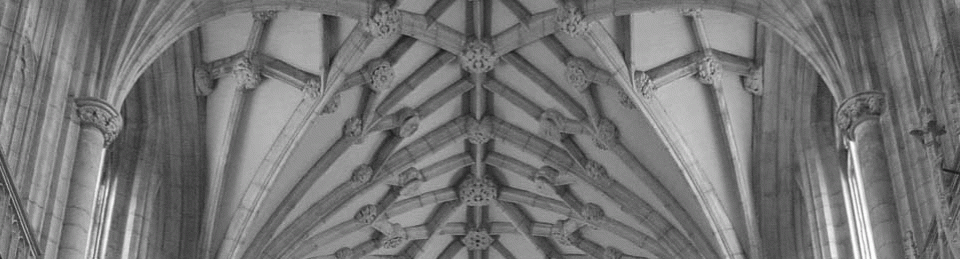
Building A Cathedral Takes Time

05 Friday Jul 2013

Posted by Kate in Process

≈ Leave a comment

Tags

journal, kids, parenting, process, progress

There was a great story circling Facebook a few months ago.

You can picture her easily. She is a mom with a college degree who has chosen to stay home with her posse of small children. A few years ago, her life was characterized by lectures and long discussions over cups of strong coffee. She wrote and read and analyzed and penned compelling reviews of her favorite books.

Now she feels lucky when she is able to string two coherent thoughts together. If she bothered to update her Goodreads account, it would list the titles of books that are less than ten pages long and made of cardboard. But she wouldn’t trade her new life for anything in the world.

Anyway, one day this mom’s friend returns from a fabulous tour of Europe. And after sharing with their group of friends some of the highlights of her trip, she pulls out a gift for her stay-at-home friend. The giftwrap and ribbon fall away to reveal a coffeetable book richly illustrated with photos of the most beautiful cathedrals in Europe.

The friend explains that the young mom is like a cathedral builder. The days are long, and sometimes it’s hard to see what you’re building. But at the end of a lifetime there will be some thing beautiful; something bigger than yourself that you have helped to shape.

I really resonated with that story. I think it is a helpful reminder not only to mothers of young children, but to any of us who are chipping away daily at tasks that are both mundane and profound–mundane up close, profound when viewed from a distance. We spend our hours in the care and nurture of small people or aged people or students or coworkers or each other, iron sharpening iron, sometimes in minute detail. We may have a life goal of becoming more like Christ, watching our own progress and sometimes observing none until we look far over our shoulders. We may invest, day by day, in the child whose attitude seems never to change or the teenager who does not seem to be listening, only to discover decades later that ours were shaping words.

The cathedral builder chipped away at a stone, set it in its place, and those single stones stacked one atop another formed a cathedral. Sometimes it took a lifetime.  Sometimes it took five.  But it all started with a raw stone, and a mason, and a chisel. It started with hard work and diligence.

So, what are your raw stones?

Mine are my kids and my husband, I can see that.  We shape one another in how we speak to each other, how we encourage one another.  We have so much growing ahead of us.

I survey other stones strewn about.  Well, there is my own life, my goals for myself, my artistic pursuits.  What am I working on that will benefit those around me? How are my pursuits shaping my own heart and soul?

Raising my eyes above my own family and my self, I am working to shape the community around me.  It’s something I get to do nearly every week as I usher God’s people into his presence through music at our church.  I want us to behold God and to marvel at God, to wonder at the Cross, to be brought low in confession and raised up in forgiveness and have hearts open to the Word of God preached.  I want our small chapel of living stones to be raised into something that brings God glory and delight and joy.  I want our little part of the Kingdom of God to reflect him brighter than the moon reflects the sun when its full and gleaming.  I want to be part of shaping that.  Music is one of our tools.

There are other tools I have used more frequently in the past, and I long to take up again.  Methods of study, disciplines of thought and writing, tools that shape me and my community.  Where did I put those tools?  I am sure they are here somewhere.

I am interested in your tools, your raw stones, your vision.  Have you caught a glimpse of what you are building?  What have you learned in the process?

Go back

Your message has been sent

Warning
Warning
Warning
Warning

Warning.

Subscribe

  • Entries (RSS)
  • Comments (RSS)

Archives

  • September 2016
  • August 2016
  • January 2016
  • November 2015
  • October 2015
  • August 2014
  • November 2013
  • September 2013
  • August 2013
  • July 2013

Categories

  • Faith
  • Grace
  • Homeschooling
  • Justice
  • Life with kids
  • Memories
  • Process
  • Teaching
  • Uncategorized
  • Writing

Meta

  • Create account
  • Log in

Blog at WordPress.com.

  • Subscribe Subscribed
    • Building A Cathedral Takes Time
    • Already have a WordPress.com account? Log in now.
    • Building A Cathedral Takes Time
    • Subscribe Subscribed
    • Sign up
    • Log in
    • Report this content
    • View site in Reader
    • Manage subscriptions
    • Collapse this bar