Endurance

Thoughts from another homeschooling mom, well worth the read.

neweyes2's avatarnew eyes

IMG_0115

I am bored. I want so badly to have a conversation that doesn’t involve the well being of children and their thoughts. I want to be involved in a conversation that is about something else. Anything else. NPR doesn’t talk back, it just tells me bad news. Movies and TV are fiction. Text messages are vague and interrupt my rhythm. I want to talk to adults. 

I have a lot to do. I teach all day Monday. I have to be ready to do that which means “mom teacher” hat goes off and “art teacher” hat gets put on. And that happens only when my children have their school work done. That is Friday, when everyone is looking forward to the weekend, I get to do my other job. I have signed up to teach another class on Fridays. It is good. We need the money. I work from the…

View original post 322 more words

The Most Important Thing

Tags

, , , , ,

On Sunday, my husband Joel preached his last of seven sermons on the seven letters to the seven churches in Revelation.  The final church was Laodicea, to whom Jesus says,

For you say, I am rich, I have prospered, and I need nothing, not realizing that you are wretched, pitiable, poor, blind, and naked. 18 I counsel you to buy from me gold refined by fire, so that you may be rich, and white garments so that you may clothe yourself and the shame of your nakedness may not be seen, and salve to anoint your eyes, so that you may see. 19 Those whom I love, I reprove and discipline, so be zealous and repent. 20 Behold, I stand at the door and knock. If anyone hears my voice and opens the door, I will come in to him and eat with him, and he with me.

These were rich, self-sufficient people.  They had designer wool for sale, special ointments and a renowned eye clinic, and lots of money.  Yet Jesus shows them the true reality: they are poor, and blind, and naked.  The words are not primarily of judgement, but reproof: I love you.  I’m showing you how you really are, not just telling you what you want to hear.  Be zealous about this.  Repent.

They had everything.  But they had nothing, because everything else was more important to them than Jesus.

And yet, he still said, “If anyone hears my voice and opens the door, I will come in to him and eat with him, and he with me.”  Because the point of his reproof is restoration, and the goal of restoration is real, true communion with his people.

What is the most important thing to me?

I mean, really?

I want it to be Jesus, the one who sacrificed everything for my redemption, who loved me from before the foundation of the world.  And yet I know in my honest heart when he gently holds the mirror before me that I am often distracted by many other things.  Buzzing about like Martha, when Christ has offered me Mary’s seat at his feat.

Tonight I was about to sing to my sweet five-year-old boy, when I noticed tears in his eyes.  He nuzzled his precious Blue Hippo to his nose, and then said softly, “If someone said I had to sell Blue Hippo to see Jesus, I would do it.”

I felt the holiness of the moment.  It was as if Jesus pulled back the covering of my son’s heart and said, “This is what I am doing in your son.  He is my son.  And he knows that seeing me is the most important thing.”

I am humbled.

It was an unexpected blessing at the end of the day, a reminder that the Lord is at work in my children even as he is at work in me.  And the work of his Holy Spirit is faithful.  It is sure.  And he will bring it to completion.

He is working in me.

I want to see Jesus, too.

Prayer. And Westmont. And my friend Kim.

Tags

, , , , ,

The back door of my office led to a wooden bridge, and beyond the bridge was a sidewalk along a retaining wall, and beyond that golden hills and familiar purple mountains.  I would leave the door open, hearing the rustle of the wind in the tall eucalyptus trees, feeling the breeze, watching for visitors who were coming to see me or to speak with Pastor Tim.

I was hired on as an assistant to the pastor.  It was a blessing.  I had graduated from seminary with my degree in Church History that May, having enjoyed four years in Boston while being filled with the love of good books and writing and ministry and The Church with a Big C.  I drove my Ford Escort back to Santa Barbara and waited for the next step. First, there was a temp agency, and I edited the plant production manual of a gas processing plant.  Not exactly what I’d had in mind, but I was grateful for some work.  And I kept waiting, and praying, as summer began to turn to fall.

And then Pastor Tim looked at me and saw an assistant.  It was a great fit.  I sat at my post outside his office, working on events and writing Bible studies to go with his sermons and creating Power Point outlines and working on generally interesting things.

But the best part was the people.

I had Maggie and Eleanor in the office, and my best friend Sheila who came in to put the bulletin together and do graphic design projects on Thursdays.

And there was Kim.

Kim and her husband were professors at Westmont.  She was in computer science, and Ken was a physics professor famous for walking on fire and laying on beds of nails and intriguing students with other physics miracles.  Kim always seemed to be smiling, laughing, with her golden hair around her lovely face, mentoring students, having them over.  When she listened, she really listened. You could see it in her eyes. And Kim and Ken had committed themselves to listening and praying, particularly with their pastor.  They came, faithfully.  They prayed, faithfully.  They were friends even when ministry got hard and people were unhappy.   One or both together, they would come through that open back door and listen and pray.

The prayers of righteous brothers and sisters are effective…

I kept working with Tim for a semester or two even after I was hired on in my dream job at Westmont.  They had needed an instructor in Church History–a professor had gone on sabbatical.  I arrived for my interview with a complete syllabus of what I planned to teach, all of the books laid out, lectures suggested…and, in a move that can be attributed only to the grace of God, they hired me to teach one class.  I jumped into teaching in January of the new millennium, and I loved it.  I was young.  I only had a master’s degree, but I had a passionate love of the subject and I thrived on keeping two steps ahead of my students.  Using the same text I had studied in seminary, adding in my favorite primary sources, taking  my students on a tour of history and Christianity in two-hour lecture blocks–it was so much fun.

And Kim and Ken were there.  Especially Kim.

When you are a twenty-six year old instructor in your first semester in a new place and know that every single other person teaching has more education than you do, you feel intimidated.  You might even keep to yourself.  And yes, you might take a nap in your office after your 8-10 am lecture because you were up til 5 preparing the PowerPoint to go along with it.  But you might well be lured out of your office if your sweet friend is always willing to sit next to you at the faculty lunches and is always shining in her encouragement and humor and asking you about your classes and generally making you feel that you fit in just perfectly.

That’s how I remember Kim–one of those friends who sees you and knows you and draws you out, even in her quiet way.

My friend Kim is suffering right now.

She has been battling Stage IV ovarian cancer for almost two years.  And in the last two weeks, the doctors at home and the doctors in her treatment at Stanford have come to the same conclusion: there is nothing more they can do.

Barring a miracle of healing, Kim will be in the presence of her Savior not too long from now.  And even as I say that, I know the greater miracle is that she will indeed be in the presence of her Savior, a truth that has shone through her life with deep and penetrating clarity, especially in suffering.

It was five years ago this week that Kim and Ken lost their home and all of their possessions when the Tea Fire swept through Montecito while they were leading a group of Westmont students on Europe semester.  They handled that tragedy with grace, with hope, with steadfastness.  They fixed their eyes on Jesus, the Author and Perfecter of their faith, who for the joy set before him endured the Cross, scorning its shame.  And I know that Kim and Ken were part of the joy set before him.  His own faithful children, scorning the shame of their particular crosses, focused on the joy set before them because of his sacrifice.

Joy.  And steadfastness.  I will add these words to my mental picture of my friend Kim, and her dear husband.  And as I pray them through this time in their lives, I know from their example that my prayers will be answered, and the Lord will meet them, and he will draw near.

And I will see my friend again.

Grandma Dorothy

Tags

, , , , ,

I just finished making a batch of chocolate chip cookies with Lily.  We don’t bake very often, but when we do she loves to add the ingredients and crack the eggs and try one chocolate chip or four, “Just to make sure they’re good.”

Chocolate chip cookies always remind me of Grandma Brown.  Whenever we would make the trek up to San Jose to visit her, she would have a couple of batches ready for us, stored in the old yellow Tupperware container on top of the fridge.  She was a cookie baking sort of grandma.

I had a deep, sweet relationship with my Grandma Brown.  Or Grandma Dorothy, as we sometimes called her, as she called herself. For most of my childhood years, she lived less than a mile away.  She moved when I was ten, but our relationship was already cemented in the hours spent together, the lounging hours, the hours at bedtime.

She will always be sixty-two in my memory, the age she was in my childhood.  Sixty-two, still working in the credit department at Robinson’s with her stylish outfits and honey-colored hair and high heels.  Petite and pretty, sipping a glass of Chardonnay on our back patio after a long day, listening to the Dodger game on the radio while my dad grilled Chris & Pitts hamburgers.  The backyard would be streaked with late afternoon sun, the grass damp from the sprinklers, everything golden and sparkling.  Vin Scully’s voice takes me right back there, and there is Grandma Dorothy, sipping her glass of wine, sneezing those tiny sneezes if she had more than half a glass.

On many Friday nights, my parents would go out to dinner–I remember them standing there in the foyer in their dressy clothes.  And we would stay home with Grandma Dorothy.  I remember her voice in the dark of the room I shared with my two sisters, guiding us back through the decades and across the prairie to her childhood on the farm in Montana.  We would marvel at the stories of barn dances, of the piano they raised with a winch to the barn loft.  You could feel the heat of the farm families packed into the barn, skirts swirling and twirling, boots stomping, cheeks flushed as the music filled the evening air.  We would giggle as she told us about doing her chores barefoot in winter, leaping from one pile of manure to another to keep her feet from freezing as she fed the animals.  We loved the tale of Uncle Bud tossing the rotten apples to the pigs, and the hilarity which ensued when the whole lot of swine became intoxicated.  We could see the young Dorothy who fell in love with the dashing young Bill Brown, playing her favorite tune at The Palm, necktie draped over his trumpet.

I was her eldest–the eldest of her five granddaughters.  And she was the eldest in her family, the first of three girls and a boy.  She always called me her eldest.

And when I think of it, I could cry for missing her.

When Jack scrunches up his nose just so, I can see her.  And I see more of her in my reflection every day.  I grew up looking like my mom, but now I look more and more like a Brown, more and more like Grandma Dorothy.

Grandma, Grandma, and Dad

Sneeze

Tags

, , , , , , ,

A friend of mine–a published children’s author of note, an amazingly creative soul, a wonderful Facebook poster–shared a quote from E. B. White yesterday: “I haven’t told why I wrote the book, but I haven’t told why I sneeze, either. A book is a sneeze.”

A sneeze.  Something that you feel compelled to do, yet can’t explain, and really doesn’t involve a great deal of forethought.  (Indeed, forethought seems to kill a lot of my sneezes.  And I hate that.  Because you need to sneeze, and you can’t.)

Anyway.

I have been letting my brain pass over this thought since she posted the quote, because I am accustomed to the sense that the writing process is Very Important.  And Challenging.  And possibly Serious. And also probably requires a great deal more focus than I am able to give it.

Right now I am typing as I lie (lay? lie? lay?  I always start second-guessing myself…) on my stomach on the sofa.  My son, who stayed home from his enrichment program today with a slight cold is reading “This is my monster,” which involves pressing a button that makes a roaring sound.  And because he is a fairly fast reader, the monster is roaring approximately every ten seconds.  And now he is asking, “When will it be time to pick Lily up?” because, after all, she is the cruise director.  This is the kind of focus of which I am currently capable.

A.W. Tozer’s advice on writing has served as my Platonic ideal:

(Sorry, brief interruption as I fix a green army paratrooper.)

A.W. Tozer’s advice on writing has served as my Platonic ideal: “The only book that should ever be written is the one that flows up from the heart, forced out by the inward pressure.”  Yes, yes, I reply!  Enough of these half-witted books about nothing, these poorly constructed diatribes, these lackluster rambles!  I shall only create Good Books, Flowing from the Heart, Forced Out Through Inward Pressure!  Only meaningful and useful and worthwhile and beautiful books.

(Ah, sorry.  Another moment of re-tying the army man to his parachute.  And, in return, receiving the accolade, “Mommy, you are the best at fixing stuff.”  Oh, little man, how I love you.)

The bottom line is that I want to write worthwhile books.  I want to commit to paper a story that will stir hearts and minds and point to Truth with a Big T.  I want to contribute to the greater conversation.

(And yet I know that there is a story being written in the margins that is my true life’s work.  And I know it can be a both/and rather than an either/or, but I also know what my focus is right now.)

I think that E. B. White is amazing because he sneezed Charlotte’s Web into existence.  I want to sneeze a beloved book into existence.  Wouldn’t that be remarkable?

So, I will continue to fill my mind with the snippets of stories–family history, tales of survival and overcoming than led to the simple fact of my existence–and good essays, and I will observe my children playing in the waves and I will nurture deep old friendships and some new ones and perhaps one day I will sneeze, and a beloved children’s classic will be born.

Isn’t that how fairies are born?

photo(3)

But excuse me.  I need to go help a small boy who just discovered a little green frog.

little frog

Nostalgia

Tags

, , , ,

It’s going to be fall soon.

My new home in Florida clings to summer, the air damp and warm, the trees in bloom with great, waxy green leaves.  The lawn is verdant, and even on cloudy days one could not mistake the weather for a drizzly winter morning.

I know this Indian Summer, as we called it in my childhood.  It’s familiar–the soaring temperatures of early September that made all of your new back-to-school outfits unbearably hot, the sunny afternoons that made you sweat in the back seat of the station wagon, feet burning in their sturdy shoes.  Our summers in California were not as fierce as they are here, and the air was not damp.  But the season always insisted on giving its all right there at the end, making you long for the quiet, dark classroom where you might be allowed to lay your head on the cool desk after recess.

I had a four-year respite from this blazing transition from summer to fall. For four years, I lived on a hill which produced an autumn that will remain my personal standard for fall until I am old and grey.  It featured trees in brilliant color, crisp mornings, slanting afternoon light.  Every step crunched underfoot, dark puddles reflected brilliantly blue sky, and the air was filled with faintly acrid burning leaves.  The orchard up the road offered its tartly sweet apple cider.

One afternoon I found myself along a favorite path, trees nearly devoid of their bright colors, the dirt instead littered with colorful confetti.  It was a wooded trail to which I still return in my memory.  I would pass along the path, solitary but safe, and come out upon the granite boulders and the sea crashing beneath.  And then I would sit on the massive stone and stare out to the horizon.  It was the perfect place for writing, for thinking, for breathing.

I miss my perch on that slab of granite.

There is a deep nostalgia tied up in my memories of New England, with its red leaves and rain haunting music and white-steepled chapels.  I cherish my own memories.  And in some faint way, I feel connected to those who walked its roads centuries ago.

I have ancestors buried there in its soft soil.  I feel a deep connection to its earth and sea, to the hopes and fears and prejudices and customs of a long-gone age.  They came seeking a new world, and now they are dusty and ancient. And I am here and now and thinking of them.

I wonder whether my steps shared small paths they crossed long ago.

In three hundred years, I wonder if anyone will think of me, or know I lived.  I will be long gone to glory, and one day we will be reunited, but on this beautiful bit of earth, I wonder if I will have left a trace.  Perhaps my distant child will wander down that path through the woods, and marvel at the autumn beauty, and find the sea, and breathe a grateful prayer.

I hope she enjoys it as much as I did.

Globes with Dents

Tags

, ,

In one week, I will finish my first day of homeschooling.

Last week,  in my excitement over leading two precocious children through the rich history of the ancient world, I bought a globe.

It’s not a fancy globe, but my children were suitably happy with it, tracing trans-Atlantic flights with their soft fingers and circumnavigating the equator with a few deft spins.  I remembered my childhood fascination with maps, atlases, and globes, and smiled inwardly at our shared interest.

But as I moved the globe aside this evening, I made a discovery: after approximately four days of living in our house, the globe has a dent.Image

Yep, a big gouge right across Mexico.

Humph.

I liked our globe.  I liked its round perfection, its little ridges marking the topography of the world, and here we are, one week in, and bam.  A big dent.  Like someone just went and bashed his car door right into Monterrey, taking out part of Baja and Mazatlan and even Corpus Christi with it.

And then suddenly the globe felt a little like my whole homeschooling career, not even yet begun.

Here I am, with one mere shelf cleared off for curriculum, with a host of ideas and questions and way more going on than any homeschooling mom in her right mind should have going on, and I feel a lot like a dented globe.  Not one of those antique globes at the far end of a spacious library with mahogany panels and leather-bound volumes, not an expensive globe glowing golden in a shaft of light with little flecks sifting silently before it.  Not picture-perfect. Not worthy of Pinterest.

It’s still colorful.  Useful.  You can still see how far it is to China, and you can marvel at how remote Antarctica is, and you can learn the things you want to know.  But imperfect. Scars from being handled.  Shortcomings.

Then I think back to why I decided to undertake this journey anyway.

I have two gifts, one age five, one age six.  They can read. They both like math and art and science.  They are insatiable learners.  And I want to take all that budding interest and feed it and nurture it and see what it turns into.  I want to get my hands dirty and help them to uncover what makes them flourish.  I want to sit beside them and coach them through the challenges of pushing yourself when something comes easy and trying even if you can’t do it perfectly the first time, or the second.  Or the third.

I want them to come away from first grade more excited about learning than they are right now.

And when I’m honest with myself, I must say that they couldn’t care less that the globe is dented, or that I don’t have our whole homeschool year planned, or that I’m not even totally sure what we’re going to do on Monday.  They’re going to learn from this dented globe.

Then, on a more profound level, I remind myself that when the God of the universe formed them, he already knew everything about the woman he was giving them as their mother and teacher, dents and all.  And he knew we’d be at this crossroads right now.  He knew the other things he’d called me to do.  And he has it all well in hand. Indeed, he has even orchestrated a set of circumstances which remind me that I’M THE DENTED GLOBE.  Even before our homeschool of awesomeness has begun, it’s already imperfect.

Because I am.  And so are my kids.

Now, I feel just about ready to begin.

Invisible People

There are invisible people at the mall.  You can hear them, but as I watched them from my perch at Starbucks, it seemed to me that few people saw them.  I observed them as they tried to make themselves visible to those passing by.

You can see the invisible people, if you want to.  Most people would rather not, because making eye contact might lead to the awkwardness of turning down the free sample of lotion at the end of the outstretched hand.  It might turn into an inescapable Spiel.

I watched the young, beautiful, dark-haired woman with the outstretched lotion as she tried to engage those who walked by.  “Excuse me!  Would you like to try a free sample?  Excuse me, sir?  Excuse me, ma’am?”  No one stopped.  Most pretended not to see her.  Many did not see her at all. 

As I approached her, it felt like breaking the fourth wall.  Who catches her eye on purpose and smiles at her and asks her what she is selling?  What would it be like not to avoid the Spiel, but to welcome it, to engage it, to ask her about her product?  What if I actually bought what she was selling, tucking it away for a future gift?  What if I became her first, and perhaps only sale of the day?

She buffed my fingernails and rubbed the salts on my hands.  She spritzed water and smoothed lotion.  She talked about the Dead Sea–so salty!–and it reminded me of the book on Israel that my grandmother gave me when I was a child.  I still remember the people floating effortlessly on the Dead Sea.  I wonder if this young woman has been to the Dead Sea.

I should have asked her.

Instead I let her finish all of her points and bought some of her products at at “deep discount” which may or may not have been a good deal but was justifiable.  My hands were smooth.  It would be a nice gift.

I could tell that she appreciated the sale, but in a very subtle way our roles reversed as she handed me the receipt.

She did not need my attention.

And now I am the invisible one.

Write. Every day.

Tags

, , ,

My uncle Bill gave me some good advice once: Write. Every day. Write something. Make an appointment and write. Just write.

That was a three years ago.

His advice came as I spent time each week working on a book that would be published under his name; and, indeed, that was only fair, since a great amount of the prose in that book was taken from two of his other books, edited down with some original devotional material added by me. It was a book that is now available on Amazon. I have two trim copies sitting on my shelf in their pale blue spines, read a few times, awaiting an audience that might appreciate their advice. But they don’t feel like mine, even if they contain sentences that I crafted and ideas that came from my mind. They feel like visitors who stayed with me for a while, visitors who enjoyed my hospitality and became good friends but now have gone about their independent lives without me.

Still, that book gave me reason to write. Maybe not every day. I had a baby and a toddler and my time at home was a jumble of Cheerios and board books and Elmo. But a couple of times each week, my beloved babysitter would drop by or it would be time for preschool and I would go to the coffee shop at the bottom of the mountain and write. And edit. And write more. I would write for seven hours, and then come home to my sweet babies.

I have always known that I wanted to write. Somewhere in my garage in a weather-sealed tub of journals, my twelve-year-old self laments, “I want to write. I have the urge. But that is all–an urge. Nothing more.” And I return to that sentiment again and again, knowing as well as that twelve-year-old person the difficulty of committing words to paper.

I wrote stories as a child. Pages and pages of fiction, booklets of poetry, and one modestly famous (in my nine-year-old mind) forty-stanza poem called The Dog Star. It was the highlight of my elementary literary achievement, appearing in abridged form (because really, who on earth would want to read a forty-stanza poem created by a fourth grader about an inventive farmhouse dog) in our school newsletter.

It’s difficult to peak at age nine.

I still remember writing that poem, sprawled out across my faux-quilt comforter in its calming shades of pink and green and white and yellow. I remember my parents in their bedroom across the hall, and shutting them out with a close of my door as the words flowed effortlessly onto the paper. I emerged after a couple of hours with my masterpiece in hand. I knew it was a winner. My classmates offered encouragement, and I was proud of my achievement, not with a haughty pride but with the pride that a sometimes-melancholy, bespectacled nine-year-old with ribbon barrettes needs to experience once in a while.

That poem would probably have passed into complete obscurity in my memory were it not for my fourth-grade teacher. He celebrated my poem. He had me recite it in front of my classmates and their parents at a class poetry reading. He recommended to my parents that I would benefit from reading the poetry of Robert Service–a very important-sounding and significant recommendation in my young mind, as if my life as a poet were laid out before me and was mine for the taking.

Write. Every day.

This is advice that I have not taken. I used to journal religiously–I have dozens of volumes crammed with my terrible handwriting, handwriting that was the subject of concerned, hushed conversation between my mother and Mrs. Merrill, the oft-maligned and strict-yet-undeneath-it-all-quite-dear third grade teacher. Those conversations resulted in a summer course of handwriting practice. Handwriting! Archaic now. But I’ve always been self-conscious about my handwriting. And now I type.

But I digress. I have journals crammed with thoughts. And then many more journals lost to computer upgrades and obsolete disk formats. I have dozens of pages of potential novels that have also been lost to the even-changing technological archive, but I doubt that we have lost anything of true value in the shift. I wrote for classes, of course. But though I was an English major in college, I don’t remember studying the art of writing. I read, I researched, I analyzed, I wrote, I became a historian. I pursued history to understand the context of the literature I loved, and ended up falling in love with history even more. Yes, I wrote–my 125-page thesis on Everyman was the triumph of my first Master’s degree. But when did I stop writing just for the fun of it?

A second Master’s degree was less about writing and much more about surviving. I loved studying in New York. I loved living ten blocks from The Cloisters, and losing myself in the medieval beauty, the stately crypt and the bejeweled manuscripts. My thirsty soul soaked it up. I read medieval drama, I studied medieval art and architecture, I soldiered on as the fellow in Medieval Studies and published the newsletter and tried to cram in my French and thousands of pages a week of reading. And I fell in love. Not with my program–with my husband. I met him two days after arriving in NYC and while I emerged from my year in New York clutching my hard-earned Master’s, I was far more ecstatic that I had met the love of my life.

Write. Every day.

As a newlywed, I had one month to finish all of the revisions on my thesis–a work which, unlike my first thesis, did not have my heart. It was utilitarian. It looked at some interesting questions. It checked the box. But I had set off for Fordham to become a doctor of medieval theology and history and spirituality, and only found one professor who seemed remotely interested in those particular questions. And so, I set that dream aside. Or, perhaps more honestly, I followed that dream to its logical end and realized that I didn’t want what lay at the end of that path. And in the crush of study, I had all but stopped writing anything with soul. I don’t blame that particular program–I was writing all the time. But I lacked the mental space and breathing room to create anything real.

Do other writers require space?

They must not, if they write every day. And perhaps I don’t either.

That was ten years ago. I finished my second Master’s degree, defended it, moved cross-country, got married, and settled into life as a newlywed in the span of four short weeks. Ten years ago.

In the past ten years, I have taught sixth grade, tossed out and re-written a Bible curriculum for said sixth graders, moved again, had two children, led worship, written songs, survived the blur and joy of small children, moved a third time, and begun a new life by the sea.

But I have all but stopped writing.

I think I need to write. Every day. Just write.
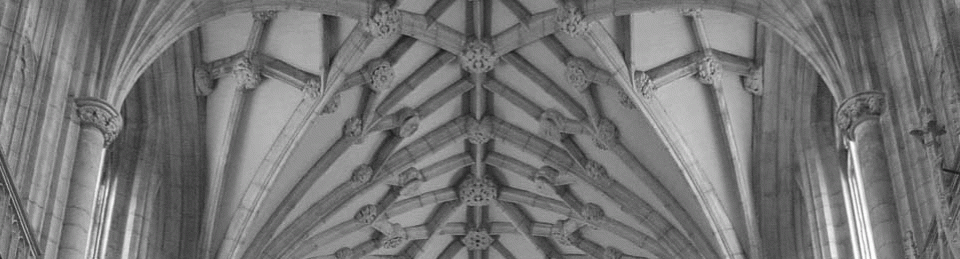
Building A Cathedral Takes Time

Tags

, , , ,

There was a great story circling Facebook a few months ago.

You can picture her easily. She is a mom with a college degree who has chosen to stay home with her posse of small children. A few years ago, her life was characterized by lectures and long discussions over cups of strong coffee. She wrote and read and analyzed and penned compelling reviews of her favorite books.

Now she feels lucky when she is able to string two coherent thoughts together. If she bothered to update her Goodreads account, it would list the titles of books that are less than ten pages long and made of cardboard. But she wouldn’t trade her new life for anything in the world.

Anyway, one day this mom’s friend returns from a fabulous tour of Europe. And after sharing with their group of friends some of the highlights of her trip, she pulls out a gift for her stay-at-home friend. The giftwrap and ribbon fall away to reveal a coffeetable book richly illustrated with photos of the most beautiful cathedrals in Europe.

The friend explains that the young mom is like a cathedral builder. The days are long, and sometimes it’s hard to see what you’re building. But at the end of a lifetime there will be some thing beautiful; something bigger than yourself that you have helped to shape.

I really resonated with that story. I think it is a helpful reminder not only to mothers of young children, but to any of us who are chipping away daily at tasks that are both mundane and profound–mundane up close, profound when viewed from a distance. We spend our hours in the care and nurture of small people or aged people or students or coworkers or each other, iron sharpening iron, sometimes in minute detail. We may have a life goal of becoming more like Christ, watching our own progress and sometimes observing none until we look far over our shoulders. We may invest, day by day, in the child whose attitude seems never to change or the teenager who does not seem to be listening, only to discover decades later that ours were shaping words.

The cathedral builder chipped away at a stone, set it in its place, and those single stones stacked one atop another formed a cathedral. Sometimes it took a lifetime.  Sometimes it took five.  But it all started with a raw stone, and a mason, and a chisel. It started with hard work and diligence.

So, what are your raw stones?

Mine are my kids and my husband, I can see that.  We shape one another in how we speak to each other, how we encourage one another.  We have so much growing ahead of us.

I survey other stones strewn about.  Well, there is my own life, my goals for myself, my artistic pursuits.  What am I working on that will benefit those around me? How are my pursuits shaping my own heart and soul?

Raising my eyes above my own family and my self, I am working to shape the community around me.  It’s something I get to do nearly every week as I usher God’s people into his presence through music at our church.  I want us to behold God and to marvel at God, to wonder at the Cross, to be brought low in confession and raised up in forgiveness and have hearts open to the Word of God preached.  I want our small chapel of living stones to be raised into something that brings God glory and delight and joy.  I want our little part of the Kingdom of God to reflect him brighter than the moon reflects the sun when its full and gleaming.  I want to be part of shaping that.  Music is one of our tools.

There are other tools I have used more frequently in the past, and I long to take up again.  Methods of study, disciplines of thought and writing, tools that shape me and my community.  Where did I put those tools?  I am sure they are here somewhere.

I am interested in your tools, your raw stones, your vision.  Have you caught a glimpse of what you are building?  What have you learned in the process?

← Back

Thank you for your response. ✨

Warning
Warning
Warning
Warning

Warning.